Wednesday, November 27, 2013
$15 Minimum Wage
This article is perfectly representative of the federalist system in the United States. While much bickering and finger-pointing goes on at the federal level of government, most of the actual policy is being created at the state, and local level. This article certainly raises the question of just how effective our federal government is, and further, just how high should our expectations for it be? Perhaps most matters are best left to state and local governance, and the federal government should keep their responsibilities simple, streamlined, and specifically defined. Of course, if the power is given to state and local municipalities, we could end up with a divided country where a $15 minimum wage is the precedent in one area, and severe voting restrictions (for example) exist in another. Which system would be better: One in which the federal government is involved with everything as a way to make all policy equal and far-reaching, or one in which states and municipalities can decide for themselves what is best?

Monday, November 11, 2013
Drones.
This article, although quite long, is completely worth reading. While it focuses on one individual who controlled drones for the United States Air Force, it also addresses the larger of issue of the United States using drones in fighting the War on Terror. I have to admit that after reading this article I strongly questioned the merits and constitutionality of our use of drones; what's your take?
Is the use of drones the best way to fight terrorists, seeing as it allows us to directly confront the enemy without actually having to mobilize soldiers. Or, is the use of drones a glaring example of the U.S. stretching the limits of our power and serious infringing upon other governments around the world.
Read this article, it's surprising, revealing, and just incredibly interesting.
Monday, November 4, 2013
Spy or Patriot?
We haven't talked a whole lot about Edward Snowden in class. The linked article provides an update on his status and the relative hard-line many U.S. politicians are taking against this individual. This story has received a lot of attention, and the so-called 'analysts' in the media have been quick to turn this story into a debate over how to label Mr. Snowden.
Some say he is an absolute traitor for telling secrets about the United States, whereas others think he's a patriot because he has revealed the level to which the National Security Administration goes to gather intelligence.
Where do you stand on this issue, and why? What should happen to Edward Snowden?
Some say he is an absolute traitor for telling secrets about the United States, whereas others think he's a patriot because he has revealed the level to which the National Security Administration goes to gather intelligence.
Where do you stand on this issue, and why? What should happen to Edward Snowden?
Monday, October 28, 2013
Income in the United States
Watch this. I'm curious what your reactions will be...surprised? Impressed? Based upon the commentary, it's clear that the source is angry about it, but we have to ask the question of whether or not this is all o.k.? Is anything illegal being done to create this disparity? If not, then shouldn't those who make this enormous amount of wealth be complimented? Or, should the entire system be changed to create some sort of equality economically in the United States? How could that be accomplished? Would that be legal?
Tuesday, October 8, 2013
Shutdown and Not Shutdown

I came across two articles this morning; this one on what our government is still doing even amid the government shutdown, and this one on one of the many effects of the government shutdown. So, how does our government prioritize? Do a little research and elaborate upon your thoughts regarding how this whole thing will end.
Tuesday, September 24, 2013
Government Shutdown?
So, our federal government is threatening another shutdown, and if it does indeed happen, there will be some very real consequences this fall. So, my question is why there is a possible shutdown looming for our federal government (and what does that even mean?). There have been threatened shutdowns in the past; these have been averted at the last minute, so why should we think this will have a different result? What do you think is going to happen, and why? Lastly, overall, how does this type of behavior make you feel about our elected officials? Are you pleased with their resolute stances on issues, or are you disgusted with their inability to compromise?
Wednesday, September 18, 2013
Of Guns and Coffee
In the wake of the horrible events that took place Monday in Washington D.C., the fervor of gun legislation has once again ramped up in our nation. Even businesses like Starbucks, known to allow customers to carry guns, are having to request that no guns actually be brought into their establishments.
There have been over a dozen mass shootings in the United States in the last 5 years, and it seems as if the debate about banning guns/certain types of guns always follows such events.
What's your take? Are these shootings preventable? Are guns to blame? Partially? Think back to the Sandy Hook shooting; what do you think about the fact that our federal government has not taken any legislative action as a response to this shooting? On the other hand, is it our governments responsibility, or even ability, to confront situations like this? Clearly there is a problem in the United States with violence; whose to blame, and what's the solution?
Monday, September 9, 2013
Should the U.S. Attack Syria?

A point, counter-point article on Syria offers a well-rounded take on the issue of whether or not the U.S. should attack this nation at war. What do you think we should do?
Is it smart for the U.S. to stand alone once again in regards to attacking a Middle Eastern country? What does it say about the U.S. if we don't attack? What are our reasons for attacking in the first place? Do we have a responsibility to respond to the horrible events taking place in Syria, or is something that can only be handled within the United Nations? What is your opinion on this crisis?
Wednesday, August 28, 2013
The President and College Tuition

This article provides a great introduction to government in several ways; it touches on federalism, presidential power, checks and balances, and the division of the private vs. public sector of the U.S. economy.
Recently, President Obama unveiled his plans overhaul higher education costs (more specifics in article). While we can all agree that college tuition costs are too high, it will be a lot more difficult to agree upon a method in which those costs can be lowered. Read the article and respond to the questions below.
Why have tuition costs increased so dramatically recently?
Can/should the president get involved in college tuition costs?
Is the president even able to have an impact upon college tuition costs?
Would congress go along with the plans outlined in the article?
What is the relationship between the federal government and public, state government-run colleges?
Do you think President Obama's ideas have the potential to lower costs? How so? What else would you like to see happen in regards to tuition costs?
Tuesday, April 23, 2013
Poverty in the United States

Short and sweet this week, take a look at the linked statistics along with the map above and develop some conclusions regarding poverty in the United States. Why does it exist where it does? What can fix it? Is it likely to get better? Worse? Why? What are some other correlating contemporary issues regarding poverty that would also be helped if poverty were to be targeted?
Sunday, April 14, 2013
Guantanamo Bay

Sometimes it's easy to forget that places like Guantanamo Bay exist, but as this article makes perfectly clear, there is certainly a crucial conflict taking place at this secretive Naval Base and prison. How should the United States handle such a crisis? Do you agree with our government's usage of prisons in other countries? What does the revolt at Guantanamo Bay tell you about this prison system maintained by the U.S. Military and do you think there is a better way? Explain your thoughts.
Monday, April 8, 2013
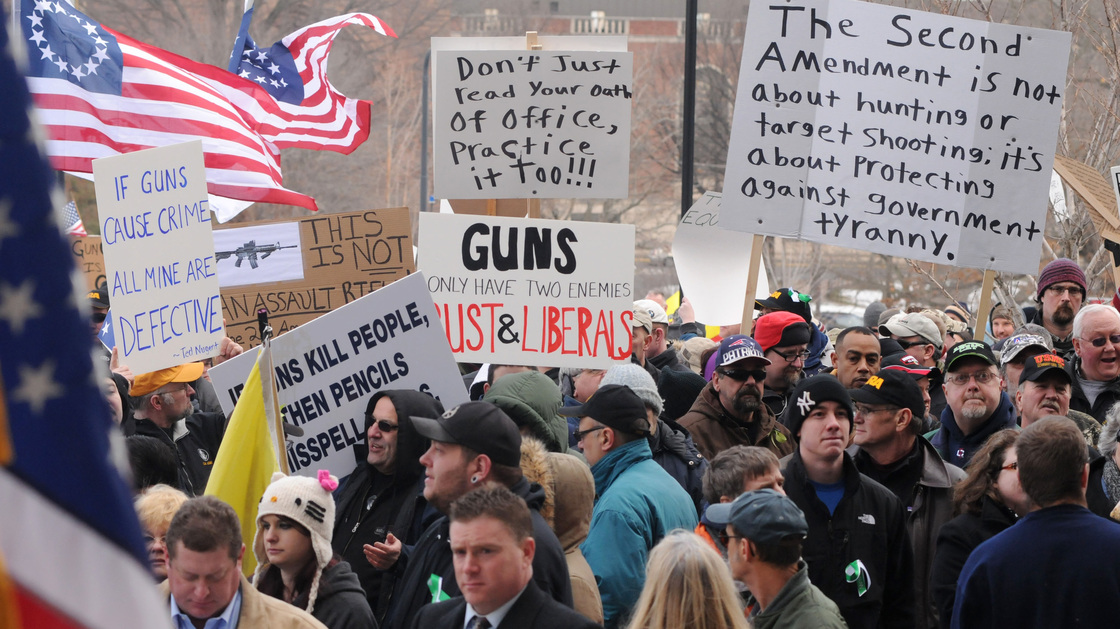
Another post on guns. Now that appears our Congress may actually debate and perhaps vote upon some gun-control legislation, it's time for them to yell at one another. The linked article discusses the concept of background checks and a registration for all legal gun owners. The argument for such an approach is to keep track of who owns guns and ensuring their sanity. The argument against such an approach is that it would allow the U.S. Government to have a catalog of people that it could follow. Is this an invasion of privacy? Does it violate the 4th amendment? The 2nd? What do you think? Lastly, do you think any of this legislation will ever be passed?
Thursday, March 21, 2013
The Supreme Court and Gay Marriage

NPR provides this timeline and article on gay marriage, mainly dealing with the Supreme Court case that will be held next month. In summary, the The Defense of Marriage Act and California's ban on gay marriage are being challenged as unconstitutional. The Supreme Court could go many ways on this; ranging from upholding these laws as constitutional to striking them down, and thus, ruling all bans/state amendments banning gay marriage as also unconstitutional. Or, they could decide somewhere in the middle.
I want you to predict what will happen and explain why, and I want you to use the Constitution as the basis of your prediction. The Supreme Court must look to the Constitution in framing their decisions, and be able to connect a modern issue like gay marriage to a 225 year old document. Which amendment(s) are relevant in this case and how do you think they will be interpreted?
Friday, March 8, 2013
South Dakota and Guns
Common sense (and the Hatch Act!) prevent me from elaborating upon my own views in regards to this article. Nevertheless, wherever one stands on the political spectrum of gun control, from pacifist to ardent 2nd Amendment supporter, allowing guns in schools will certainly raise the eyebrows of even the most casual of political interests.
What I find most interesting about the article is that 58% of individuals polled believe that school employees who are licensed to carry a gun should be able to at school. Do you find this interesting? Perhaps surprising? I would like to say that I do.
Will this serve a bellwether to other states? Many additional states have similar legislation in the works.
Earn yourself some extra credit by commenting with your take on this. Is South Dakota's law a watershed moment for American political culture, or will it be ignored and forgotten without incident? There is so much to think about with this issue, and so many opinions to consider, let's get a conversation rolling about this.
What I find most interesting about the article is that 58% of individuals polled believe that school employees who are licensed to carry a gun should be able to at school. Do you find this interesting? Perhaps surprising? I would like to say that I do.
Will this serve a bellwether to other states? Many additional states have similar legislation in the works.
Earn yourself some extra credit by commenting with your take on this. Is South Dakota's law a watershed moment for American political culture, or will it be ignored and forgotten without incident? There is so much to think about with this issue, and so many opinions to consider, let's get a conversation rolling about this.
Tuesday, March 5, 2013
Interest Groups and Rating Politicians
The New York Times recently published this interactive regarding how the National Rifle Association rates members of Congress. The graphic explains how these grades are derived, and the accompanying article provides insight into the entire gun debate currently taking place in the United States.
I found it to be a wonderful example of how an interest group attempts to impact both policy and voting behavior. What do you think?
Another interesting way to analyze this post is to think about the fact that the N.R.A. is largely backed by, and supportive of, Republican politicians (as evidenced by the ratings), and New York Times is notoriously liberal. So, is the New York Times essentially acting as an anti-NRA interest group by publishing this, or by publishing this are they actually supporting the agenda of the NRA?
Lots of fun stuff to analyze; let me know what you think.
Sunday, February 24, 2013
The Politics of Taxing and Spending
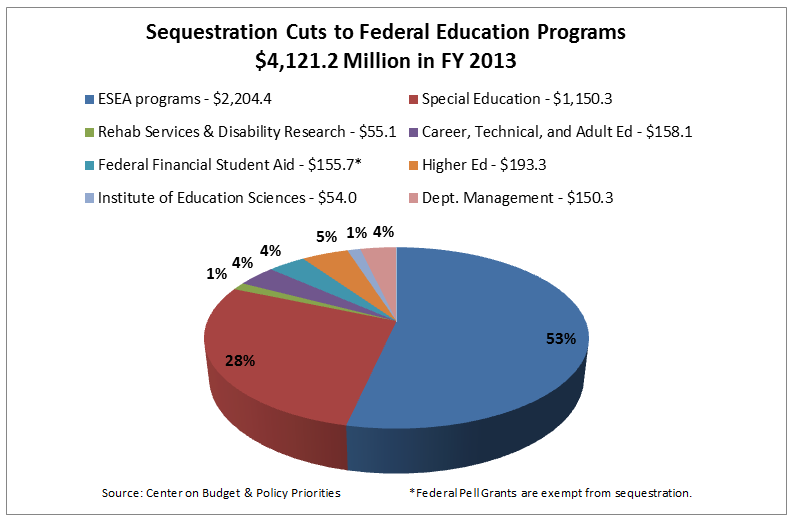
Here we go again. That whole 'fiscal cliff' crisis from 2 months ago is back. This time politicians have labeled it 'the sequester' and it included about $85 billion in cuts. The chart above provides a pie chart of the cuts to education that would happen if no deal is reached by the end of the month.
Some are calling this whole breakdown of communication between our two political parties childish, ridiculous, and horrible-considering that those who will feel the effects of such cuts are those who simply cannot live without the benefits.
Others are saying the cuts must happen, and thus will serve as a wake-up call to all the current hard line politicians who would rather play politics than actually serve the people they represent. Further, they claim, $85 billion in a budget of $3 trillion is minor. (Unless of course you depend on the programs that would be drastically cut).
What's your take?
Friday, February 15, 2013
2012 and Political Ads: A Year in Review
2012 saw a record number of political ads. Why did this happen? Is this a problem? What's the solution? Do these ads even make a difference? What's your reaction when you see a political ad? At what point do you think people make up in terms of who to vote for? Take a look at the article, view the Clint Eastwood commercial, and comment with your thoughts. Happy Presidents Day on Monday!
Saturday, February 9, 2013
The Supreme Court

I like that they aren't all looking at the camera here.
This article elaborates upon the discussion we had in class regarding the Supreme Court's upcoming case on gay marriage. Notice that there are actually two cases being lumped together, and also notice the interesting influence the Obama Administration has on the court by making public comments and filing briefs with the court (yes, like Amicus Curiae briefs, even though they aren't an interest group). What Constitutional Amendment(s) will be considered in the case? How do you think the case will be decided, and why? How do you think the case should be decided, and why?
Thursday, January 31, 2013
Thoughts for a second term President

What are your thoughts on the President's second term? What's your number one hope for the next four years in the United States? Which specific policy would you like to see our government address, and how would you like our government to legislate within that issue?
What type of leadership style do you wish President Obama to assume in his second term? What's the best way for him to lead and, as a result, get our divided government out of gridlock, and on a path to progress?
Friday, January 18, 2013
27 Words
There is, perhaps, no other sentence in American government or politics that stirs up as much debate as the 2nd Amendment to the Constitution. NPR wrote a great article about this. Read the article and respond with your own interpretation of the 2nd Amendment. What do you think it means? How should gun ownership be regulated, if at all? Do you guns only belong in the hands of a militia, or is that concept outdated, and thus, moot?
Lastly, is senseless violence something the U.S. Government can combat with tighter gun regulations, or is the problem much bigger than that?
Sunday, January 13, 2013
Intersection of psychology and politics
This Ted Talk video demonstrates the intersection of psychology and politics/government. So, naturally, I found it incredibly interesting, and I hope you do too. Essentially, the talk revolves around the notion that our political system is rather disfunctional and that a psychology lesson or two would really improve the way things are run in Washington D.C.
View the video (~20 min.) and comment on the practicailty of the suggestions offered. Is it likely that the solutions to our governmental problems rest in psychology?
Friday, January 4, 2013
113th Congress

The 113th U.S. Congress was sworn in very recently, and with it a number of firsts, milestones, and hopes. Does this article leave you with optimism about our Congress, are you of the belief that they will get things done, operate in meaningful ways, and get away from the partisan divide that has gridlocked our country for the past four years?
Further, what is your number one policy that you hope to see passed in the next year by this Congress, and why? Lastly, is your policy goal realistic and likely? Why/why not?
Wednesday, January 2, 2013
What would you do?

So, what would you do in regards to the two major issues the article brings up, and why? What is the best economic direction for the United States in the future?
Subscribe to:
Posts (Atom)